
Cattle Corral Placement Helps Conservation
New insights into certain cattle ranching practices have been given by a Kenyan scientist. These will benefit lions as well as one of the animals they prey on, the endangered Jackson’s hartebeest.
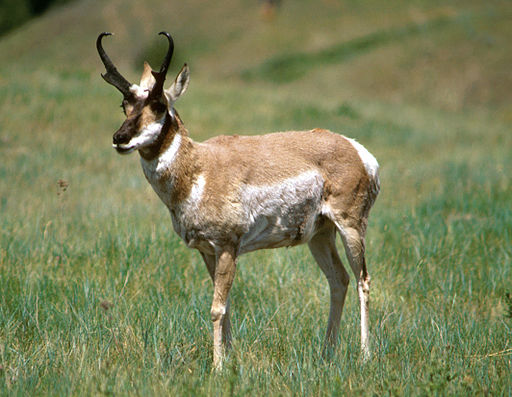 Image: By Leupold, James C. (cropped version; original is here) [Public domain or Public domain], via Wikimedia Commons
 Endangered African antelope, as well as the lions that prey on them, may benefit from certain cattle ranching practices in Kenya. This is according to research newly published in Frontiers in Ecology and Evolution.
Caroline Ng’weno, who conducted the research during her graduate studies at the University of Wyoming, is one of the first, if not the first, Kenyan women to have earned a Ph.D. working as a field biologist in Kenya. Ng’weno now heads the Pride of Meru program for the Born Free Foundation, which is dedicated to research and protection of lions in central Kenya. Her work has provided new insights into the interaction among Jackson’s hartebeest, a species of conservation concern, other wild ungulates, cattle, and lions in Kenya’s Ol Pejeta Conservancy. This is an area which is managed for both wildlife conservation and cattle ranching.
Jackson’s hartebeest is a large antelope that can weigh over 400 pounds, with an elongated forehead and oddly-shaped horns exceeding 40cm. As detailed in the results of the study, this species has been in significant decline in that part of Kenya since the reintroduction of lions in the late 1980s. That’s primarily because hartebeest share savanna habitat with zebras, the primary prey of the approximately 70 lions comprising five prides in the conservancy.
“Predation risk for hartebeest was elevated in association with zebra, implying that apparent competition with zebra may negatively impact hartebeest populations,” Ng’weno and fellow researchers wrote. That’s in line with previous research that shows secondary prey such as hartebeest can suffer significant population declines when large carnivores are restored to an ecosystem after a long absence.
The research involved capturing and placing GPS collars on lions in five different prides representing 70 individuals, identification and tracking of 179 hartebeest and analysis of 246 sites where lions killed animals. The scientists also studied lion predation on buffalo, zebras, impala and warthogs. Notably, they found that the proximity of buffalo to zebras reduced the risk of predation on buffalo, contrary to the relative risk for hartebeest.
Restoration of lions to the Ol Pejeta Conservancy and elsewhere in central Kenya resulted from greater tolerance by ranch managers, following decades of shooting and poisoning of the top predators. That’s because ranch managers are increasingly recognising that tourism resulting from abundant wildlife populations can help them sustain their livestock operations in drought years and other lean times. However, the decline of hartebeest numbers has led some ranch managers to considering reimplementing lethal control of lions.
According to Ng’weno’s research, the ranchers could hold the key to maintaining both the lion and hartebeest populations.
It turns out that abandoned cattle corrals create nutrient hotspots called glades that attract zebras, and therefore lions – but not hartebeest. And the researchers showed that survival of hartebeest in areas without glades was more than twice as high as in areas with glades.
So, ranch managers’ placement of cattle corrals away from hartebeest likely would allow the antelope species to increase, with lions focused on the zebras that congregate at the resulting glades.
The authors of the study write: “In our study system, spatial separation between zebra and hartebeest improved survival rates of hartebeest, probably by reducing encounters with lions hunting in areas with high zebra densities. Strategic placement of glades, therefore, offers a promising approach to creating refuges for hartebeest and perhaps other species of secondary prey.”
While some might argue that eliminating glades through reduction of cattle production might be an option for hartebeest conservation, the researchers say that’s not practical. That’s because ranchers are unlikely to reduce cattle numbers voluntarily, and reducing cattle numbers would likely boost zebra numbers, along with lions, as cattle and zebra diets overlap. The researchers note that predation by lions on cattle is rare compared to predation on zebras.
“Alternative conservation interventions are required for the long-term persistence of lions and their prey not only on Ol Pejeta Conservancy, but more widely in (Kenya’s) Laikipia County and the whole of sub-Saharan Africa,” they wrote.
Sorry, comments are closed on this post