
Komodo Dragons Threatened by Climate Change
The Komodo Dragon, already under threat from habitat loss, has found to be also threatened by climate change – both rising temperatures and rising sea-levels. Researchers predict local extinctions and urge rapid intervention.
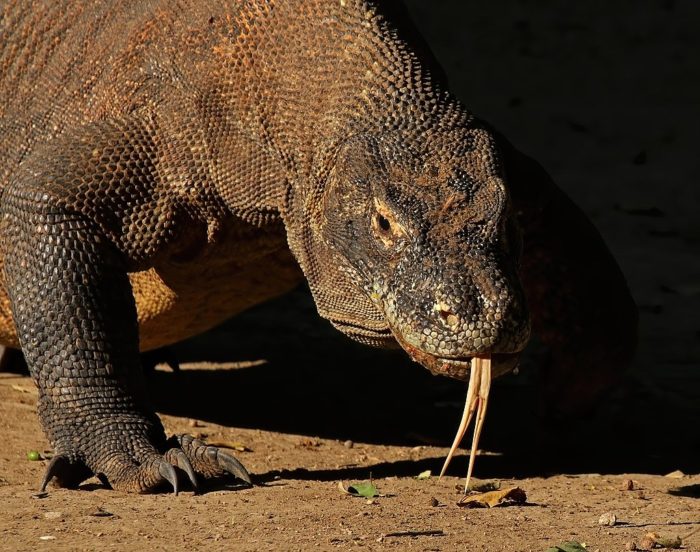 Image: Charles J Sharp, CC BY-SA 4.0
 The world’s largest lizard, the Komodo dragon, could be driven to extinction by climate change unless significant measures to intervene are taken soon.
A new international study, led by the University of Adelaide and Deakin University, has found that the impact of both global warming and sea-level rise threatens the extinction of Komodo dragons, which already have restricted habitats, and this must be better incorporated into conservation strategies.
Lead author Dr Alice Jones, from the University of Adelaide’s School of Biological Sciences, says: “Climate change is likely to cause a sharp decline in the availability of habitat for Komodo dragons, severely reducing their abundance in a matter of decades. Our models predict local extinction on three of the five island habitats where Komodo dragons are found today.”
The Komodo dragon is the world’s most iconic lizard species which has existed on Earth for more than a million years, but only an estimated 4000 individuals survive in the wild. They are endemic to five islands in southeast Indonesia: Komodo, Rinca, Nusa Kode and Gili Motang which are part of Komodo National Park, and Flores, the fifth and largest island which has three nature reserves.
Dr Jones continues: “Current-day conservation strategies are not enough to avoid species decline in the face of climate change. This is because climate change will compound the negative effects of already small, isolated populations. Interventions such as establishing new reserves in areas that are predicted to sustain high-quality habitats in the future, despite global warming, could work to lessen the effects of climate change on Komodo dragons.
This study, which is published in the journal Ecology and Evolution, is the result of many years of fieldwork on the ecology and conservation status of Komodo dragons.
“Using this data and knowledge in conservation models has provided a rare opportunity to understand climate change impacts on Indonesia’s exceptional but highly vulnerable biodiversity,” said co-author Dr Tim Jessop, School of Life and Environmental Sciences, Deakin University.
Importantly, the research project involved close collaboration with the Komodo National Park and the Eastern Lesser Sunda Central Bureau for Conservation of Natural Resources.
Co-author Deni Purwandana, Coordinator of the Komodo Survival Program, explains: “The severity and extent of human actions impacting Komodo dragon populations, especially on Flores Island, are only just being realised. Having an insight into future impacts of climate change provides new possibilities to work with conservation agencies and local communities to find on-ground solutions that will limit climate and other threats to Komodo dragons and their habitats.”
The researchers say climate-change-informed decisions should be a common part of conservation practice.
“Our conservation models show that Komodo dragons on two protected large islands are less vulnerable to climate change. However, even these island habitats might not provide an adequate insurance policy for the survival of the species,” says Associate Professor Damien Fordham from the University of Adelaide’s Environment Institute. “Conservation managers in coming decades may need to consider translocating animals to sites where Komodo dragons have not been found for many decades. This scenario can be tested easily using our approach. Our research shows that without taking immediate action to mitigate climatic change, we risk committing many range restricted species like Komodo dragons to extinction.”


No comments yet.