
Agricultural Chemicals: May Have “Cide” Effects
The use of pesticides is still common place in today’s world, although we’ve come a long way since DDTs, it is essential to feed a growing population.
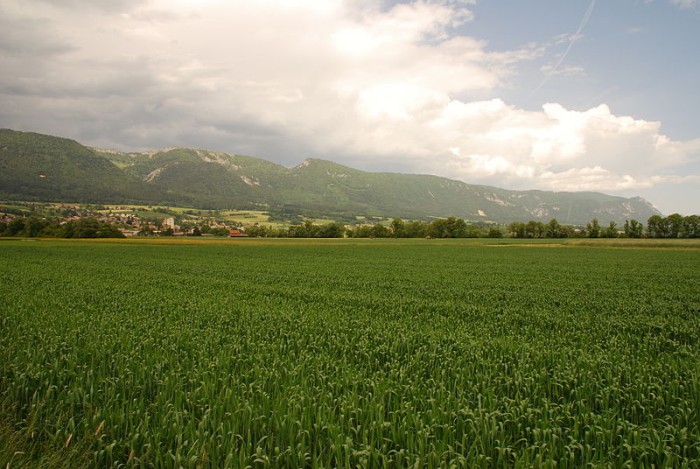 Image: By Sudhanwa (Flickr: Wheat fields, Grenchen) [CC-BY-SA-2.0 (http://creativecommons.org/licenses/by-sa/2.0)], via Wikimedia Commons
 It’s surprising how much impact our day to day lives have on the world around us. We can affect areas thousands of miles away, such as the Antarctic, just by spraying pesticides on fields, a topic I have covered in my previous post: “How far can pollution go, the Arctic?”. The use of pesticides is still common place in today’s world, although we’ve come a long way since DDTs, it is essential to feed a growing population. As well as this we use herbicides both industrially and to keep our gardens weed free. What direct impact do these chemicals have?
Herbicides alter the body shape of tadpoles
This came from an article I read recently on a study done in Pittsburgh looking at the effect of a common everyday weed killer on the shape of tadpoles. The study found that the weed killer caused tadpoles to develop longer tails. This is a normal adaptation to the presence of predators in the water. Any evidence of predators alters the production of stress hormones in tadpoles, bringing about the elongation of their tails. Weed killers have the same effect but the tail of a tadpole will become almost twice as long. When a tadpole’s tail is this long it becomes a handicap rather than a beneficial adaptation.
Pesticides can stop one of our most important pollinators, bees, navigating and reproducing.
A few recent studies have looked into the effect of pesticides on honey bees and bumblebees. The results from a study on honey bees show that neonicitinoid pesticides impair a bee’s ability to successfully navigate out to foraging sites and back to the hive, a behaviour that allows honey bees to systematically exploit good foraging sites and bring back food to the hive. This attribute is common in eusocial insects. If bees are unable to return home with food this could have an effect on the hive and its honey production.
The study on bumblebees suggests that colonies exposed to these pesticides produce fewer queens thus decreasing the potential for population growth. This is quite unfortunate as bumble bees act as pollinators of the crops these pesticides are designed to protect.
Good motivation for further development!
Studies like these make us question our impact on the environment through the various chemicals we use to modify it for our benefit. In the long run this could hopefully help us to come up with more environmentally friendly ways of doing this.

No comments yet.