
Tracking Turtles
Scientists have used innovative ways to track female loggerhead turtles. The data reveals that return to the same nesting beaches to lay eggs year after year, therefore, these key locations should be a focus for conservation efforts.
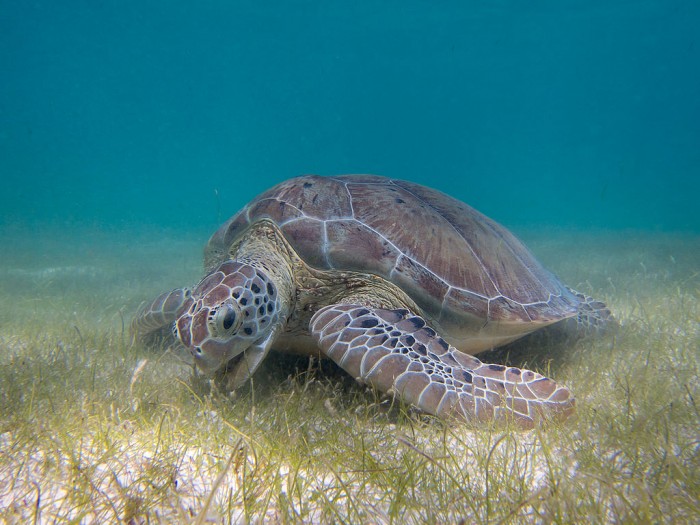 Image: By P.Lindgren (Own work) [CC BY-SA 3.0 (http://creativecommons.org/licenses/by-sa/3.0)], via Wikimedia Commons
 Given that many endangered marine species migrate over long distances, often travelling thousands of kilometres across remote areas, to reach habitats critical to their survival, it is hugely important for scientists to understand their movements and identify these areas. They are also particularly vulnerable to overexploitation, habitat loss and climate change, but a lack of knowledge of where and how these species move throughout their lives makes it challenging to protect them.
Loggerhead turtles are named for their large heads that support powerful jaw muscles, allowing them to crush hard-shelled prey like clams and sea urchins. They are less likely to be hunted for their meat or shell compared to other sea turtles, however, because they frequently come into contact with fisheries, they are threatened by getting accidentally caught in fishing gear. Many of their nesting beaches are also under threat from tourism development.
University of Exeter scientists used satellite tracking and “stable isotope ratios”, a chemical signature also used by forensic scientists, to track female loggerheads from two rookeries (nesting beaches) in the Mediterranean. Their results were published recently in the journal Diversity and Distributions.
The study identified three main feeding areas – the Adriatic region, the Tunisian Plateau and the eastern Mediterranean.
Lead author Julia Haywood, of the University of Exeter, said: “We show where the majority of nesting female turtles spend the most of their life, meaning that in addition to their nesting beaches we can also protect important marine habitats where they feed. Nearly half of the Cyprus nesting population feeds on the Tunisian Plateau, an area known to have some of the highest turtle bycatch (accidental catch by humans fishing) in the world. Therefore, we support recommendations that this area should be conserved.”
The study tracked turtles from rookeries in Greece and Cyprus using data from 1993 to 2018.
“By studying these turtles for so long we show these females stay in the same feeding area over decades, which means if these habitats are damaged or have high fishing activities then the turtles will unfortunately not move. This work shows the importance of combining satellite tracking and stable isotopes to help understand these elusive animals,” Haywood said.
The work was carried out in collaboration with the local conservation groups: the Society for the Protection of Turtles in North Cyprus (SPOT) and ARCHELON, the Sea Turtle Protection Society of Greece.
Robin Snape, of SPOT, said: “Mediterranean loggerheads lay their nests in the European Union, just at the time of year when hundreds of thousands of European tourists arrive on holiday. For the rest of the year, many female loggerheads are growing and foraging in the waters off Africa, where mortality in industrialised fisheries and even direct consumption of turtles are still big concerns. Each year at least 10,000 turtles die as accidental bycatch off North Africa, while illegal trade in turtle meat persists. This research allows prioritisation of conservation resources to specific threats in specific areas.”

Sorry, comments are closed on this post