
Cheetahs in Asia?
They were declared extinct in India 60 years ago, but may be back in the country as early as next year.
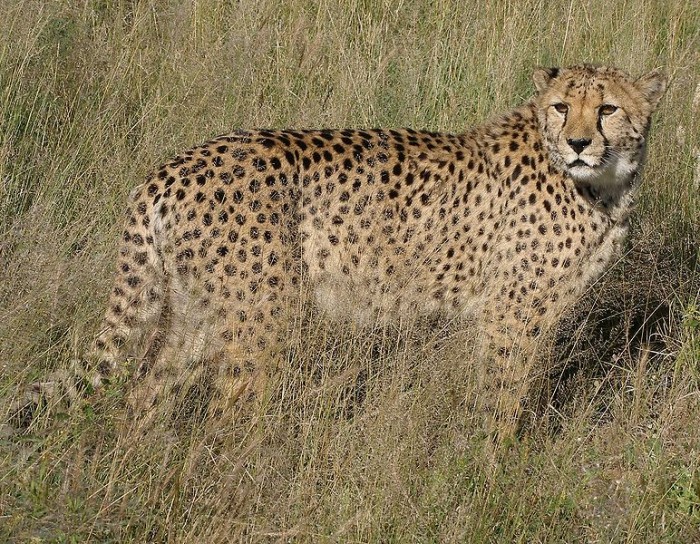 Image: By Falense (Own work) [GFDL (http://www.gnu.org/copyleft/fdl.html) or CC-BY-SA-3.0 (http://creativecommons.org/licenses/by-sa/3.0/)], via Wikimedia Commons
 The cheetah, the most docile of all big cats, is an icon of African savannahs. Their distribution once spanned four continents – Africa, Asia, Europe and North America – but ten thousand years ago, climate change wiped out all but one species, now found only in Africa and in a few locations in Asia. A dramatic reduction in numbers meant that cheetahs were forced to breed with close relatives, causing them to become genetically inbred. They now exhibit much lower genetic variation than other mammals, resulting in poor sperm quality, greater susceptibility to disease, and much lower survivorship.
Now the Indian government, with help from the Cheetah Conservation Fund (CCF), is hoping to expand the Asian population by re-introducing cheetahs to India. They were declared extinct in India 60 years ago, but may be back in the country as early as next year. If the re-introduction is successful, it would make India the only country in the world to host six of the world’s eight big cats, and the only country to have all the large cats of Asia.
CCF will aid the Wild Trust of India (WTI) with the re-introductions, as they have experience of cheetah releases in various locations in Namibia. Field inspections have been conducted and, as a result, the Palpur-Kuno Wildlife Sanctuary has been chosen for the first release.
The cost will amount to over £500,000 and critics of the plan suggest that the money, and conservation efforts, should be used to help save the tiger. However, it is hoped that the cheetahs will help restore the grasslands of India, the way that tigers help restore forest ecosystems. CCF will provide an experienced ranger to help train the local rangers and the WTI researchers who will monitor the cheetahs. Conservation biologists from India have also attended courses run by CCF including livestock and predator management.
CCF has advised that communications and training programmes be put in place to promote harmonious living between local people and predators. It is hoped that the cheetahs will help the ecotourism industry to thrive so that jobs and business opportunities will be created for local people, and conflict between a burgeoning human population and wild animals will be mitigated.


No comments yet.